
Social Security Denials: Davenport SSDI & SSI Appeals Help
More Than 60 Years of Combined Experience Focused Solely on SSDI & SSI Appeals
Most Social Security disability claims are denied the first time. For many claimants, the appeals process is where cases are often decided, but navigating it without help is a serious disadvantage. Missed deadlines, incomplete medical evidence, and poorly prepared arguments are among the most common reasons appeals fail. The stakes are high, and the process is unforgiving.
At Bowman, DePree & Murphy, we handle nothing outside of Social Security and Veterans Disability matters. That singular focus means every attorney on our team has spent their career learning the SSA’s procedures, the standards that govern disability determinations, and the arguments used at each stage of the process. Our attorneys bring more than 60 years of combined experience to every appeal, and clients work directly with an attorney, not staff or assistants.
When you come to us after a denial, we review your case to find what went wrong, gather and organize the evidence needed to address it, and build a strong argument for your appeal. We’ve served clients in Clinton, Muscatine, Scott, and Rock Island counties since 1992.
Contact us for a free SSDI and SSI appeals consultation. Reach Bowman, DePree & Murphy at (563) 412-4755 or through our online contact form to get started.

Stay In The Know
-
When Should I Apply for Benefits?Unless you have an obvious long-term disability, the best time to apply for Social Security disability benefits is 6-9 months after you stop working.
-
When Do You Suggest I Hire a Lawyer?Most claimants wait until their claims are denied on reconsideration before hiring a lawyer. Most observers agree this timing works well because it is at a hearing that having a lawyer truly makes a difference.
-
When Am I Likely to Receive a Hearing?It can take up to two years from request until a hearing is held and a decision issued, but the time varies from state to state.
-
Maximizing SSI Benefits in Davenport: Strategies & TipsApplying For Disability BenefitsRead Article
-
 Social Security Disability Benefits After a StrokeApplying For Disability BenefitsRead Article
 -
Social Security Disability Benefits for Soft Tissue Injuries / BurnsApplying For Disability BenefitsRead Article
-
Social Security Disability Benefits for SchizophreniaApplying For Disability BenefitsRead Article
-
Social Security Disability Benefits for Multiple SclerosisApplying For Disability BenefitsRead Article
-
Social Security Disability Benefits for LeukemiaApplying For Disability BenefitsRead Article

The Appeals Process in Social Security Disability
Social Security disability claims move through four levels of administrative adjudication:
- Initial determination
- Reconsideration determination
- Hearing before an administrative law judge
- Review by the Appeals Council
After exhausting all four levels, a claimant may file in federal court. The deadline for most Social Security disability appeals is 60 days from the date you receive a decision. Because SSA presumes receipt within five days, the effective deadline is 65 days from the decision date. The one exception: appeals from an ALJ denial to the Appeals Council following a federal court remand carry a 30-day deadline.
Initial & Reconsideration Determinations
Social Security disability claims can be filed online, by phone through an SSA teleservice center, or in person at a local SSA office. At the initial and reconsideration stages, SSA doesn’t make disability determinations itself. Claims are referred to a state agency contracted with SSA. A medical doctor and a disability examiner typically evaluate the claim. SSA then adopts those findings.
One important detail: an application for benefits is one of the few forms in a disability case that generally can’t be signed by a lawyer on your behalf unless a court has appointed them to do so. An attorney may help you complete it, but the signature must be yours.
If you’re dissatisfied with the initial determination, you can appeal. In most states, the first appeal is a reconsideration, which is a second look by a different team at the same state agency. Relatively few reconsideration determinations result in a benefits award. The more consequential step is requesting a hearing before an ALJ.
The ALJ Hearing
After you request a hearing, an attorney advisor may review the file, request additional evidence, and hold an informal prehearing conference, usually by phone with your attorney. In some cases, the attorney advisor issues a fully favorable decision before the hearing takes place. If that happens, the hearing request is dismissed unless you ask to proceed within 60 days of receiving notice of the decision. The Appeals Council, not an ALJ, has authority to review an attorney advisor’s decision.
Hearings may be held in person or by video teleconference. Vocational and medical experts may testify. The process isn’t adversarial. After the hearing, the ALJ issues a written decision.
Why ALJ Hearings Produce Dramatically Different Outcomes
State agencies and ALJs approach disability differently, and the difference in outcomes is substantial. State agency decision-makers review only the file. They rarely look beyond medical findings to consider how your condition actually affects your ability to work.
At the state agency level, the Listing of Impairments is frequently used as the basis for favorable decisions and, despite legal challenges, often as the unstated basis for denials, particularly for claimants under 50. If a younger claimant’s condition doesn’t meet a Listing, the state agency is unlikely to find them disabled. State agencies also apply standardized formulas to determine residual functional capacity (RFC), treating everyone with similar medical findings the same. Few of those formulas conclude a claimant can do less than a wide range of sedentary work.
ALJs take a different approach. They view medical findings as setting the parameters for a range of possible RFCs and evaluate the full record, including your credibility, to determine which RFC most accurately reflects your actual capacity. The numbers reflect that difference: ALJs find claimants under 50 disabled far more often than state agency decision-makers do.
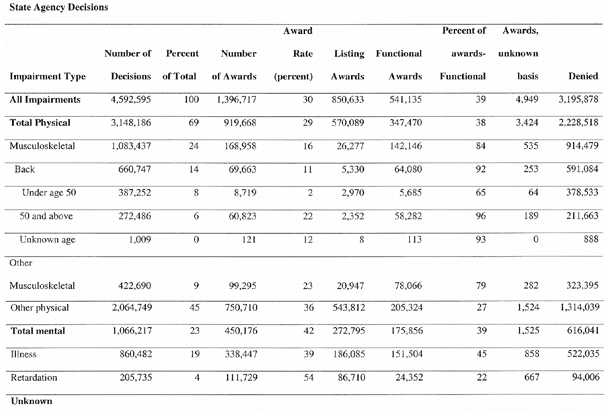
The chart below is drawn from an SSA study comparing state agency and ALJ disability decisions. During the period studied, ALJs found claimants with back impairments disabled 75% of the time; state agencies did so only 11% of the time. For claimants under 50 with back impairments, the gap was even wider: state agencies found disability in 2% of cases, while ALJs found it in 68%.
Good Cause for a Late Appeal
If you miss the deadline to appeal a denial, you can ask SSA to extend it by showing “good cause” for the delay. To do so, you must submit a detailed letter with your appeal explaining why the request was untimely. Depending on the circumstances, SSA may also require an affidavit from you. If SSA accepts good cause, it will extend the deadline.
We can advise you on what good cause requires and help you put together the documentation SSA needs.
How We Help Clients Through the SSDI and SSI Appeals Process
Because we handle nothing outside of Social Security and Veterans Disability matters, our attorneys bring their full attention to every appeal. Clients work directly with an attorney at every stage, not with staff or assistants. Here’s what that looks like in practice:
- Case evaluation: We review your denial to identify what went wrong, including missing evidence, documentation gaps, or errors in how the state agency assessed your condition, and build a strategy around those findings.
- Evidence gathering: A strong appeal depends on a complete, well-organized record. We gather medical records, personal documentation, and any additional evidence needed to support your claim.
- Appeal preparation: We prepare a thorough, accurate presentation of your medical condition and how it affects your ability to work, not just the paperwork, but the argument behind it.
- ALJ hearing representation: We represent you at your hearing, present your case, and respond to any questions the ALJ raises. Having an attorney at the hearing affects how a case is presented.
- Communication throughout: We keep you informed at every stage so you understand where your case stands and what comes next.
- Advocacy at every level: Whether before SSA representatives or an ALJ, we advocate for you using our knowledge of the process.
Attorney Thad Murphy is a member of NOSSCR (National Organization of Social Security Claimants’ Representatives). Our representation is offered on a no-win, no-fee basis, and you pay legal fees only if we secure benefits for you. Free initial personal consultations are available so you can understand your options before deciding how to proceed.
Taking Your Appeal to Federal Court
When the Appeals Council denies review or issues an unfavorable decision, the administrative process is exhausted. At that point, a claimant may file a civil lawsuit in U.S. federal district court. The deadline is 60 days from receipt of the Appeals Council’s decision, so timing matters. Iowa disability cases from the Davenport area fall under the jurisdiction of the U.S. District Court.
Federal court is the final level of appeal in Social Security disability cases. At Bowman, DePree & Murphy, we can take your appeal through federal court when administrative remedies have been exhausted. That ability is one of the things that sets us apart from many other practices handling SSDI and SSI matters in the region.
Call us at (563) 412-4755 or contact us online to schedule a free consultation and discuss your next steps.
Hear From Our Happy Clients
See Why We Will Make a Difference for Your Case & Get You the Rights You Deserve.
-
"I cannot say enough positive things about having Thad Murphy as my disability lawyer."He walked me thru each step of the process and made sure everything was in order and ready for my appeal. I spoke to many different lawyers before I decided to go with Mr. Murphy and I think it was one of the most important decisions I ever made.- Tim S.
-
"I could never have done it again or been successful without Mr. Murphy's help.& dedication to his clients."I tried 10+ years to get my disability only to be told No over and over. I was frustrated, worried, and tired of trying & fighting only to be told NO yet again. A friend told me about Bowman, DePree & Murphy in Davenport. I'd heard the name in pass- Charity M.
-
"I can now rest my head."I just like to thank you Michael Dupree for being my savior which has changed my life for the better unfortunately disability is a part now but thanks to you.- Nathaniel L.
-
"Great Disability attorney! My decision to work with Mr. Thad Murphy was life changing, at the right time."Mr. Murphy was able to get my disability on the first appeal and charged a very fair rate which was under the cap from my settlement of back pay from being off for five years.- Benjamin B.
-
"I love this place!"They helped me out with my disability when I couldn't get it on my own. Thank you so much y'all!- Tammy H.
-
"I only wish I would have reached out sooner. Fair, Honest, and will work for your Win."HIGHLY RECOMMEND this Office!! My case was very complex, and had me exhausted. I had been looking for the right Attorney, and found him right here. Thad Murphy handled my case in an amazing amount of time.- Sandra R.
-
"Everything you would expect."Did a great job with explaining the steps we need to take to secure our future and our children.- Amy S.
-
"I would recommend him or this office to anyone who needs help!"I had the honor to work with Mr. Murphy. He handled my disability case. He is very understanding and is there if you have questions.- Amber W.
-
"They got my disability for me very quickly."So very pleased! I referred 5 friends to them and they got their disability for them as well! Two from Davenport area, and three in Burlington!! GREAT ATTORNEYS!!! I'm still recommending them!- Melody L.